
Guide · Brief
The morning brief, and how its numbers are checked
How the brief is written from a pack of facts, why each percentage and price has to cite one, and what happens when a draft fails the check.
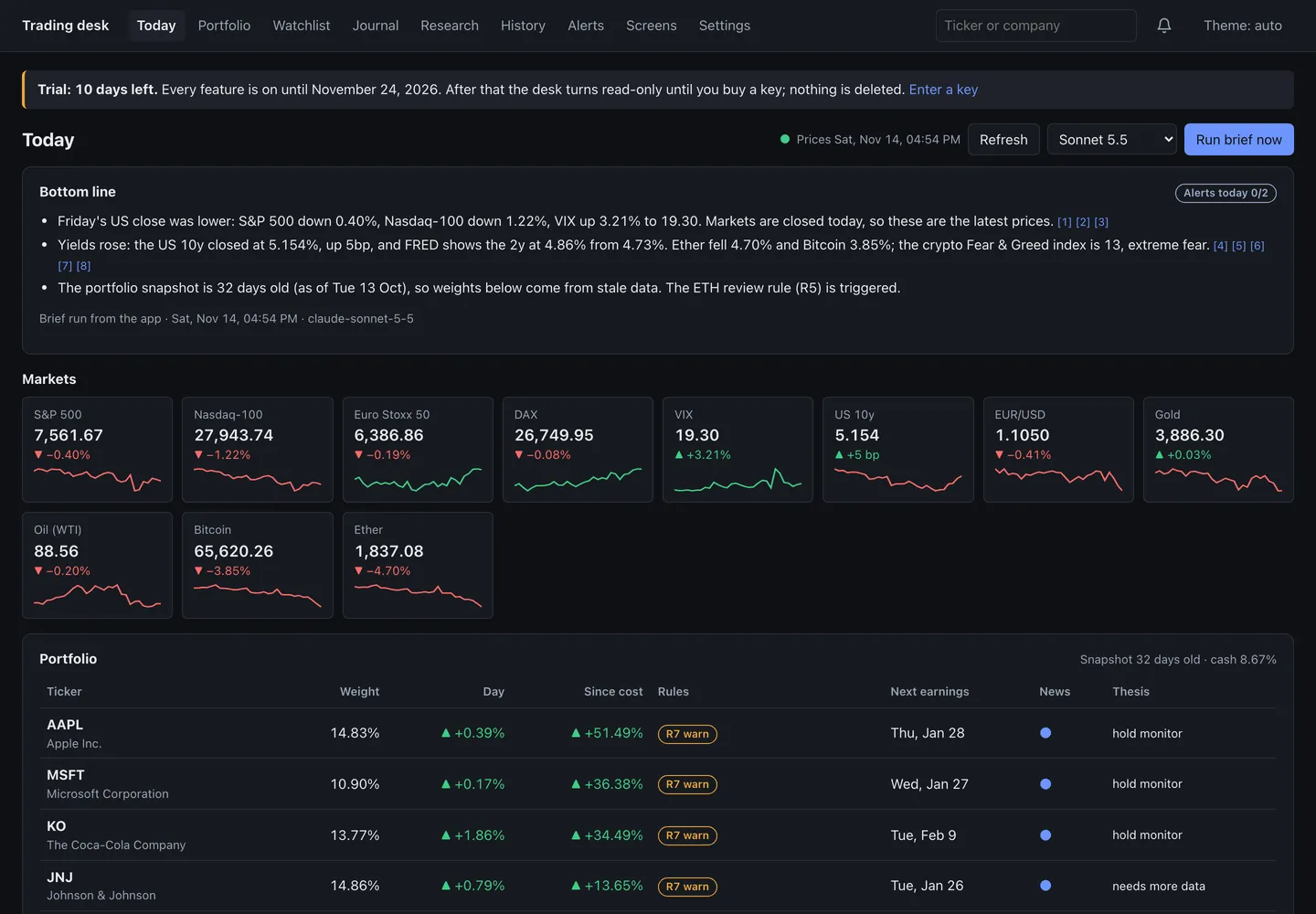
The morning brief is a short summary of the markets, your holdings and your rule results, written by your own AI assistant (Claude Code or Codex). What makes it different is what happens before you see it: code checks each percentage and price in it against the fact it cites. Small counts, dates and the wording around a figure are not checked.
Writing one
On Today, pick a model next to Run brief now and press it. The desk fetches the latest data and writes the brief; it says "This takes a minute or two". A brief you run yourself is shown in the app and is not sent to your phone. To have one written every morning, turn on the schedule.
The facts pack
The AI does not browse or guess. It gets one pack of facts from the desk, each with an id, a source and a link: market prices, macro figures, news headlines, filings, calendar dates and your holdings. For your portfolio the pack holds percentages only: each holding's weight, its move today and its change since cost, its themes and its thesis state. It never holds how many shares you have or any amount in money.
The check
Every bullet has to cite the facts it uses, and code then checks the draft. It is rejected if:
- a percentage or price is not backed by a fact the same bullet cites, including the direction ("rose" or "fell");
- it cites a fact id that does not exist;
- it uses a banned phrase, such as "you should buy", "guaranteed" or "will rise";
- it is too long, or not in the expected shape.
A rejected draft goes back to the AI once, with the problems listed. If the second draft also fails, or the AI is not available, you get a digest written by code instead, and the brief says so ("code-written digest").
Reading it
- Bottom line: one to three bullets, with numbered links to their sources.
- Macro, Holdings, Rules, Data health: the details. News that a publisher claims is labelled as that publisher's claim.
- Data health says plainly when something is stale or missing, such as an old portfolio snapshot.
A brief is decision support, not advice. It reports what the data says and what your rules found; it never tells you to buy or sell.